
In May 2024, the CoRE-MH was officially launched at Uppsala University. This involved a two day event, including public panel discussions and a closed participatory workshop with all partners to identify key thematic research areas for the CoRE.
Read the full report here.
Public symposium
A public symposium was held on day 1. Three panels featuring researchers and representatives from the African Union, the European Commission, International Organisations and civil society were held to explore key areas of interest relating to understanding and responding to migration and health across the AU-EU migration corridor, focusing on:
- The role of International and regional organisations and agencies in promoting migrant health across AU-EU
- The role of national agencies and ministries in promoting refugee and migrant health by supporting evidence to policy and practice translation across the AU-EU migration corridor
- The role of research and innovation in enhancing positive outcomes of migration for all: working with academia and civil society


An overview of discussions and key takeaways from each panel can be found in the meeting report. Some of the key priority areas for the CoRE to engage with include:
- Health consequences of EU migration policies, focusing on data gaps and lack of attention to affected populations: compromised healthcare access due to social determinants and policy developments; lack of access to services, including healthcare, for refugees in limbo; and the importance of data-driven policies to mitigate medical health consequences of migration.
- Humanitarian aid, policy, and international solidarity: the importance of humanitarian agencies in search and rescue operations on the Mediterranean; successful examples of international solidarity in humanitarian work emphasised, including African Union and African CDC.
- Challenges of communicating nuanced research findings on migration to the general public and policymakers; public opinion on migration is more nuanced than expected; universities have an important role in working with civil society institutions, while acknowledging challenges in aligning timeframes and cultural differences; academics emphasise interdisciplinary approach to refugee research and policy.
- Managing large numbers of refugees and migrants in a compassionate and comprehensive approach: this is a shared responsibility; for example, in 2019, the African Union launched a migration policy framework to address the needs of 80% of Africans living outside the continent.
- Migration challenges and the need for data-driven policies: the importance of including a health system and incident management team in emergency response efforts; the importance of contingency planning and international support; the need for the international community to address the root causes of migration, including conflict and financial crisis, and to provide universal health coverage for all migrants who face barriers to accessing healthcare, academics advocate for better implementation of strategies; the importance of international cooperation in achieving global access to healthcare; and, the need for a holistic approach to addressing migration challenges.
Co-producing a research agenda
On day 2, a closed workshop with CoRE partners involved group discussions to identify the scaffolding for a co-created research agenda.


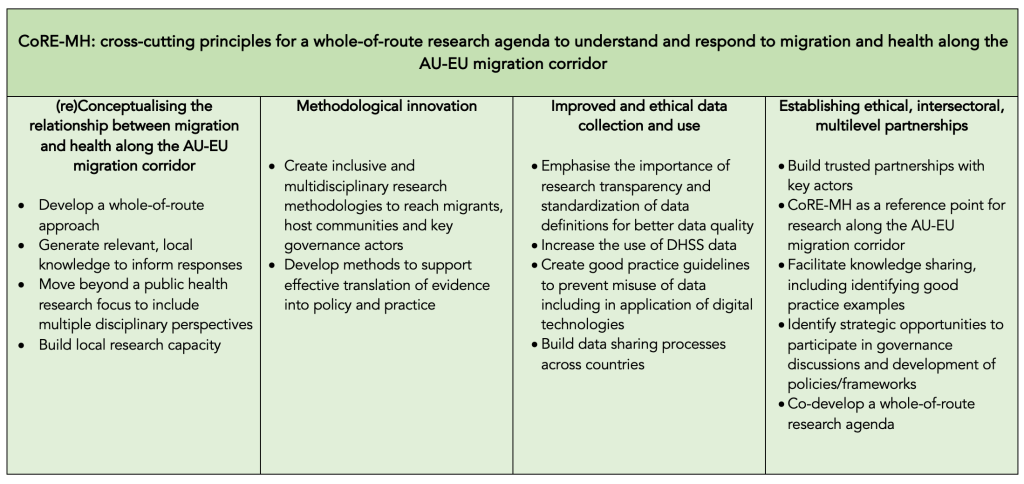
The cross-cutting principles and priority research identified by partners areas are summarised below and will be used to guide the action plan of the CoRE moving forward.
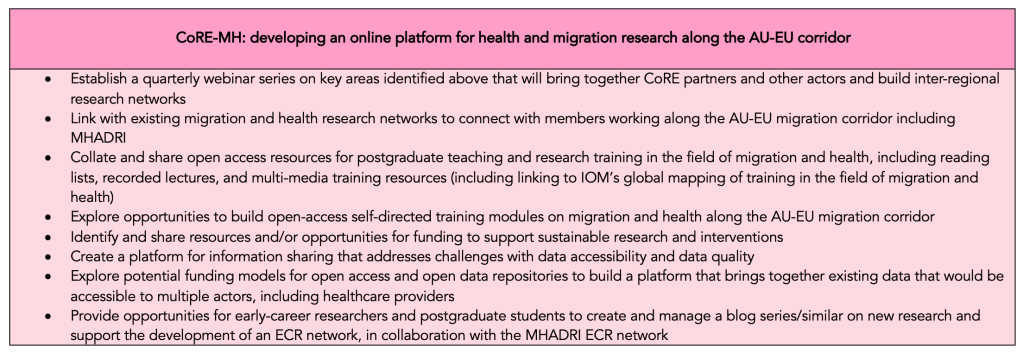
Partners highlighted the opportunities the CoRE presents for developing an online platform for health and migration research along the AU-EU corridor.

Read the full report here.