
Originally published online by The Guild
https://www.the-guild.eu/news/2024/inaugural-africa-europe-core-conference-fostering-.html
Images (C) SCPS Photography

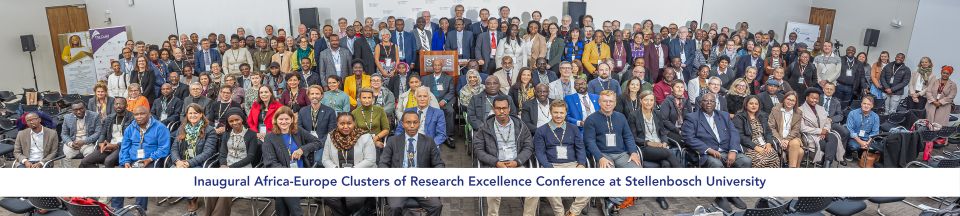
Stellenbosch University (SU) provided the setting for the first Africa-Europe CoRE conference where researchers from the 21 joint Africa Europe Clusters of Research Excellence (CoRE) led by ARUA (the African Research Universities Alliance) and The Guild of European Research-Intensive Universities (The Guild) gathered to take stock of the first year of the CoRE initiative, exchange best practices, and explore new interdisciplinary connections essential to addressing societal and scientific challenges in African and European societies.
Participants attended sessions on AU-EU policy featuring high-level speakers from both Africa and Europe, engaged in various breakout sessions and workshops to discuss the state of play of the individual clusters and had in-depth thematic discussions on topics such as health disparities, artificial intelligence and sustainable development. Participants also presented their work underlining key achievements, which include securing funding, establishing training programmes, building research networks and publishing in top scientific journals.
Academics from each of the 21 CoREs presented achievements, practices and challenges from the first year since their establishment. The presentations were grouped according to the priority areas of public health, green transition, innovation and technology and capacities for science, nevertheless the plenary showed many linkages between the CoREs in research content and the nature of their groundbreaking approaches to having an impact in African and European societies. Across all the CoREs, there was broad agreement that taking on a CoRE form has already galvanised their collaboration and given time to resolve barriers to equitability, even if time and effort is needed to make this a reality. Interdisciplinarity and the integration of activities focused on research, innovation and education were all commonly brought, although each CoRE had their own approach defined by the local contexts in which they want to make an impact and the state of the art in the various fields they work in.

Secretary-General of The Guild Jan Palmowski highlighted the huge amount of progress that had been made in a short amount of time. Within only a year, CoREs have become energetic drivers for innovative initiatives, including fostering new academic fields to address key societal challenges, hosting successful masterclasses for research students, and submitting successful funding bids to national funders and EU bodies for research and training initiatives. He noted that “we have come far, and this bodes well for our long-term commitment of equitable partnerships for excellence and capacity building. As we seek to build new coalitions with a wider public and with policymakers, it is important never to lose sight of our core goal – transformative research for the welfare of our societies, in Africa but also in Europe.”

Secretary-General of ARUA John Gyapong highlighted the need to increase Africa’s research output, retain talent within the continent and foster collaboration with European partners. He also emphasised the critical contributions made by ARUA’s original Centres of Excellence, which continued to thrive – many of them are also key participants in the joint CoREs which are co-led with The Guild institutions.
In her keynote speech, Professor ‘Funmi Olonisakin, Vice-President: International, Engagement and Service at King’s College London described the initiative as the building block of an academic movement to change the world. “This collaboration is not just about research; it is about creating something special, something different,” she said. “We are not just researchers; we are change-makers. This is how we build a movement of knowledge producers that are effective in changing society.”

Olonisakin stressed the importance of equitable partnerships, recognising that African universities are often disadvantaged by structural inequalities. “We are not starting from a level playing field. We must be mindful of these gaps and build equitable frameworks that bring others along with us,” she cautioned and pointed out that existing inequalities between African and European institutions, such as access to infrastructure and funding, must be addressed if the partnership is to succeed.
In a second keynote, Prof. Thuli Madonsela, former Public Prosecutor of South Africa and Professor of Law at Stellenbosch University, spoke about the importance of interdisciplinarity as a matter of social justice, focusing not only on how we can compensate for nature’s arbitrariness (John Rawls), but also for human capriciousness. It was, she argued, only by looking at problems from an interdisciplinary perspective that we can avoid particularist perspectives that ignore certain viewpoints and ensure the notion of ‘ubuntu’, of humanity for all.
In his keynote address, Daan du Toit, Acting Director-General for International Cooperation at the South African Ministry of Science and Technology, highlighted the progress South African research had made since 2000, with an almost 10-fold growth of research output since then. Du Toit highlighted the three national priorities of the new South African government (1. Inclusive growth and job creation; 2. reducing poverty; 3. to build a capable, ethical and developmental state), and how research and innovation were critical to all of these. He went on to note the significant alignment between South Africa and EU R&I priorities, and his support for the AU-EU Innovation Agenda. Noting the importance of international collaboration to address key societal challenges, du Toit expressed his strong encouragement for the CoREs, noting his keen desire to work with African partners and Europe to address our shared concerns through science and innovation.
Sean Rowlands, Senior Policy Officer at The Guild provided a roadmap for the Africa-Europe CoREs on how to navigate the complex funding landscape and optimally utilise the AU-EU Innovation Agenda. In his session he emphasised the innovative form that CoREs have established with multilateral collaborations, spread across different countries different regions on both continents, with long-term action plans that integrate research, innovation, education and capacity building. The institutional support that has seeded these CoREs and enabled a productive first year of activities shows dedication to equitable partnerships as it has given a space and some certainty to build an understanding that enhances collaboration. He argues that it also gives the consortia a competitive edge to be more successful in securing funding from a variety of programmes because the participants and vision are in place. The CoREs intention is to ramp up their fundraising activities, with the hope that the AU-EU Innovation agenda can continue to spark opportunities that match the breadth of approaches, scientific excellence and ambition needed to address our shared, global challenges.
The third day continued with a policy roundtable discussion bringing together key stakeholders from the European Union (EU) and African Union (AU), national research agencies and university leadership to explore how the Africa-Europe Clusters of Research Excellence are framed by the AU-EU Innovation Agenda and can help support the Agenda.
Botho Kebabonye Bayendi from the African Union urged researchers to ensure their work directly contributes to the continent’s ambitious goals, particularly as Africa enters what she described as a ‘decade of acceleration’. Bayendi commended the conference’s focus on issues such as climate change, food security and skills development, which align with the AU’s strategic objectives. “We are saying African solutions for African problems and the agenda should be citizen driven,” she stressed.
Laurent Bochereau, EU Science Counsellor to the African Union, applauded the CoRE activities he has been monitoring for some time and described the three-day conference as a fruitful opportunity to meet academics in person to learn more about how they are already contributing to the AU-EU Innovation Agenda. He thanked the CoRE initiative led by ARUA and The Guild for its engagement with the evolution of the funding opportunities, particularly the upcoming Africa Initiative calls in Horizon Europe.
The conference concluded with inspiring reflections on what was achieved with an outlook towards the future of the initiative.
Professor Anders Hagfeldt, Chair of The Guild and Vice-Chancellor of Uppsala University in Sweden, said building trust and fostering collaboration requires a deep understanding of each other’s backgrounds and histories, reinforcing the value of listening in creating meaningful partnerships. “We can say with confidence that we’re doing something very important. On many levels this initiative is game-changing,” Hagfeldt remarked.
Jan Palmowski, Secretary-General of The Guild, added: “Perhaps the most important outcome was the energy amongst all the participants, including the policymakers who joined us for such an extended period of time. Our researchers used this opportunity not just to develop their own CoRE, but to meet across disciplines and explore new approaches right across the disciplinary spectrum: fantastic evidence that societal challenges know no disciplinary boundaries: when it comes to addressing our health challenges, our climate crisis, or poverty – it’s all (disciplines’) hands on deck!”
Originally published online by The Guild
https://www.the-guild.eu/news/2024/inaugural-africa-europe-core-conference-fostering-.html
Images (C) SCPS Photography